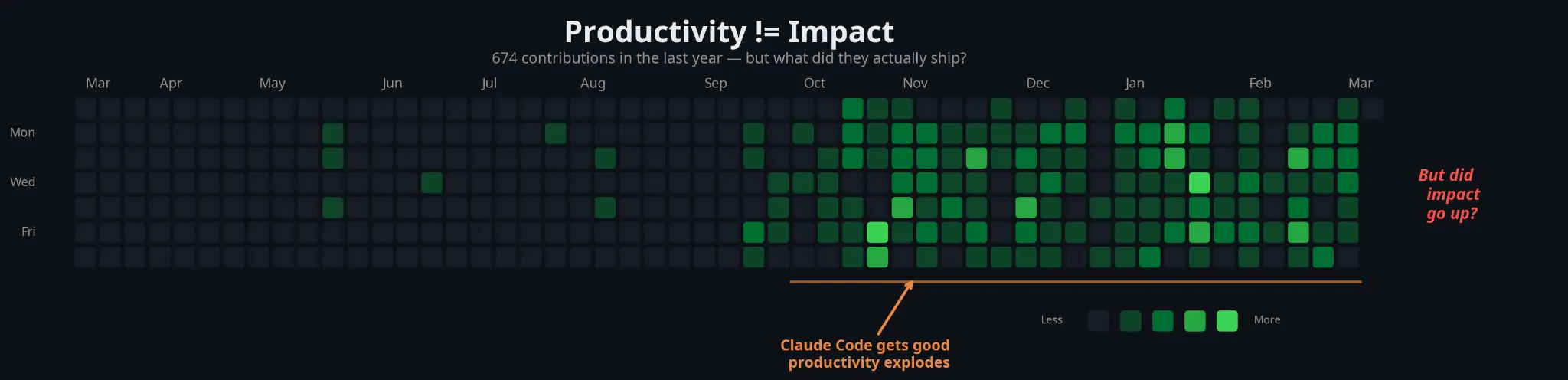
This is my GitHub contribution history. See that wall of green that erupts around October 2025? It looks like the chart of a 10x developer, right? It’s the story of my coding output going supernova. But it’s also a lie.
That chart doesn’t show a 10x increase in my impact. It hides a story of frustration, stagnation, and a passion project that went absolutely nowhere. It’s a perfect picture of the modern developer’s dilemma: we’re mistaking activity for achievement.
The AI Gold Rush
Before late 2025, my workflow was standard-issue software development: a mix of deep work, creative bursts, and the usual slog of writing boilerplate, setting up tests, and hunting down bugs. Progress was steady, but it was a grind.
Then, around November 2025, AI coding assistants—especially Claude Code—got good. Really good. They went from being a fancy autocomplete to something more like a tireless, slightly weird junior programmer. The nature of my work changed overnight. The AI handled the grunt work. It wrote the boilerplate, generated test suites, and refactored messy codebases in seconds. Hours of my day were suddenly handed back to me.
My personal productivity, at least by the crude metric of green squares on a GitHub heatmap, went vertical. I was a commit machine. I was, by all appearances, the most productive I’d ever been.
A Case Study in Going Nowhere, Fast
So what did I do with all that reclaimed time? I poured it into a side project: a commercial Android app I called “SSH Browser.” (Quick disclaimer: this is a personal project, completely separate from my day job.) The idea was simple: a mobile browser that tunnels all your web traffic through an SSH connection—private, encrypted browsing from your phone. With my AI sidekick, I wasn’t just sprinting; I was flying. I built the entire app in a few weeks—a project that would have taken me months, if not a year, just a short while before.
And then I hit a wall. Not a technical wall. A bureaucratic one.
When I submitted SSH Browser to the Google Play Store, my velocity slammed into a brick wall. The project wasn’t blocked by bugs, performance issues, or a lack of features. It was blocked by things that have nothing to do with code: an opaque review process, maddening permission policies essential for an SSH client, and a slow-motion back-and-forth with a review team that seemed to operate on a different timeline from the rest of the universe.
Despite the flurry of commits and the clean, AI-assisted code, the app had zero users. Zero downloads. Zero impact. My GitHub heatmap was a lush, vibrant forest of green, but the project was going nowhere.
We’re Measuring the Wrong Things
The story of SSH Browser is a painful but perfect example of the productivity paradox. And while this was a side project, the lesson isn’t limited to side projects. I see the same dynamic at work in my day job, too—teams shipping features at record speed while the real blockers are cross-team alignment, policy reviews, or waiting on decisions that no amount of code can accelerate. We have tools that can 10x the act of coding, but the real bottlenecks to making an impact often live entirely outside the IDE.
This whole experience made me realize how much we rely on vanity metrics. We love to track GitHub contributions, lines of code, and story points. They feel tangible. They give us a sense of forward motion. But they’re just proxies. They measure activity, not achievement.
So, what should we measure instead? I’m not sure I have the perfect answer, but I’m starting to think about a different set of questions:
- How fast can we get a real product into a user’s hands? (Time to first user)
- How quickly can we learn from that user? (Speed of learning)
- Are we shipping value, or just features? (Rate of impact)
The most important work, I’ve realized, is often not the coding. It’s navigating the organizational, legal, market, and bureaucratic challenges—the stuff our AI assistants can’t do for us. Not yet, anyway.
The Real Work
My GitHub heatmap tells a story of incredible productivity. But the real story, the one that matters, is the one it doesn’t tell. It’s the story of a stalled project and the hard-won lesson that activity and impact are not the same thing.
As AI continues to get woven into the fabric of our work, I’m not going to urge you to do anything. But I will say this: I’m starting to look past the satisfying green squares of my contribution graph. I’m asking myself what I’m really building, and whether it’s actually going anywhere.
Because it turns out, distinguishing between motion and progress is the hardest part of the job.